aleatory.processes.InverseGaussian#
- class aleatory.processes.InverseGaussian(mu=1.0, scale=1.0, T=1.0, rng=None)[source]#
Inverse Gaussian process#
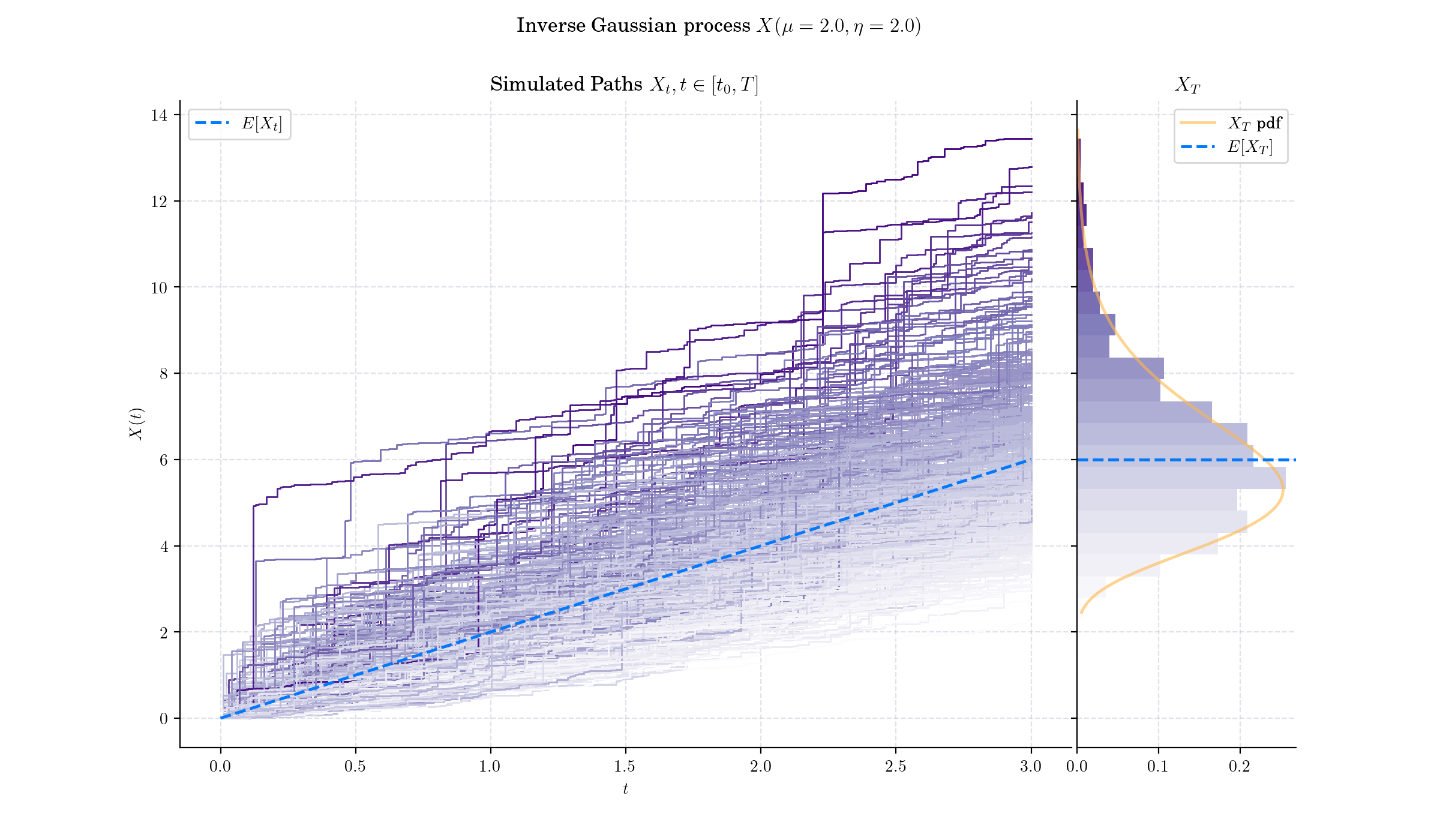
Notes#
An Inverse Gaussian process is a stochastic process \(\{X(t),t\geq 0\}\) where:
\(X(0)=0\),
the increments \(X(t)−X(s)\) (for all \(t>s\)) are independent and follow the Inverse Gaussian distribution with mean \(\mu(t-s)\) and scale parameter \(\eta\).
Constructor, Methods, and Attributes#
- __init__(mu=1.0, scale=1.0, T=1.0, rng=None)[source]#
- Parameters:
mu (double) – the \(\mu>0\) which defines the mean of the increments of the Inverse Gaussian process.
scale (double) – the \(\eta>0\) which defines the scale of the increments of the Inverse Gaussian process
rng (numpy.random.Generator) – a custom random number generator
Methods
__init__([mu, scale, T, rng])- parameter double mu:
the \(\mu>0\) which defines the mean of the increments of the Inverse Gaussian process.
draw(n, N[, marginal, envelope, mode, title])Simulates and plots paths/trajectories from the instanced stochastic process.
estimate_covariances([times])estimate_expectations()estimate_quantiles(q)estimate_stds()estimate_variances()get_marginal(t)plot(n, N[, mode, title])Simulates and plots paths/trajectories from the instanced stochastic process.
process_covariance([times])process_expectation()process_stds()process_variance()sample(n)simulate(n, N[, T])Simulate paths/trajectories from the instanced stochastic process.
Attributes
TEnd time of the process.
rng