aleatory.processes.HawkesProcess#
- class aleatory.processes.HawkesProcess(mu=1.0, alpha=1.0, beta=1.0, rng=None)[source]#
Hawkes process#
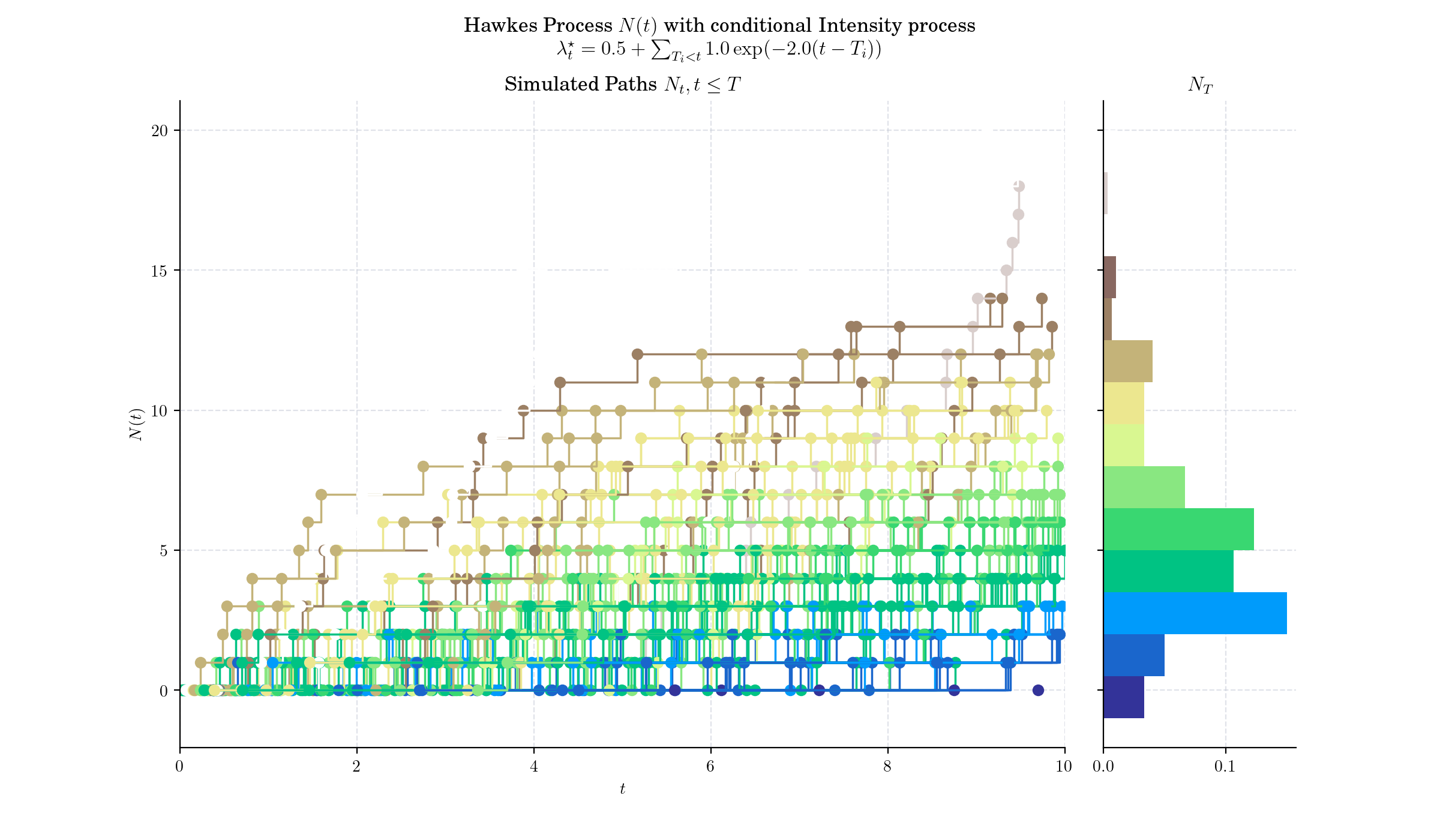
Notes#
A Hawkes process is a counting process \(N(t)\) whose conditional intensity process is given by
\[\lambda^{\ast}(t) = \mu + \sum_{T_i <t} \phi(t-T_i), \qquad t\geq 0,\]where
\(\mu>0\) is the baseline intensity (rate of events in the absence of previous events) or background arrival rate
\(\phi: \mathbb{R}^{+}\rightarrow \mathbb{R}\), is the excitation function or triggering kernel, a non-negative function representing the influence of past events, and
\(T_i\), are the times of prior events.
In particular, we assume
\[\phi(t) = \alpha \exp(-\beta t)\]i.e. an exponentially decaying excitation function.
Constructor, Methods, and Attributes#
- __init__(mu=1.0, alpha=1.0, beta=1.0, rng=None)[source]#
- Parameters:
mu (double) – the baseline intensity
alpha (double) – the \(\alpha >0\) in the excitation function above
beta (double) – the \(\beta >0\) in the excitation function above
beta – the \(\beta >0\) in the excitation function above
rng (numpy.random.Generator) – a custom random number generator
Methods
__init__([mu, alpha, beta, rng])- parameter double mu:
the baseline intensity
draw(N[, T, style, colormap, mode, title, ...])plot(N[, T, title, suptitle])sample([T])simulate(N[, T])Simulate paths/trajectories from the instanced stochastic process.
Attributes
alphaintensitymurng