aleatory.processes.GaltonWatson#
- class aleatory.processes.GaltonWatson(mu=1.0, rng=None)[source]#
Galton-Watson process#
Notes#
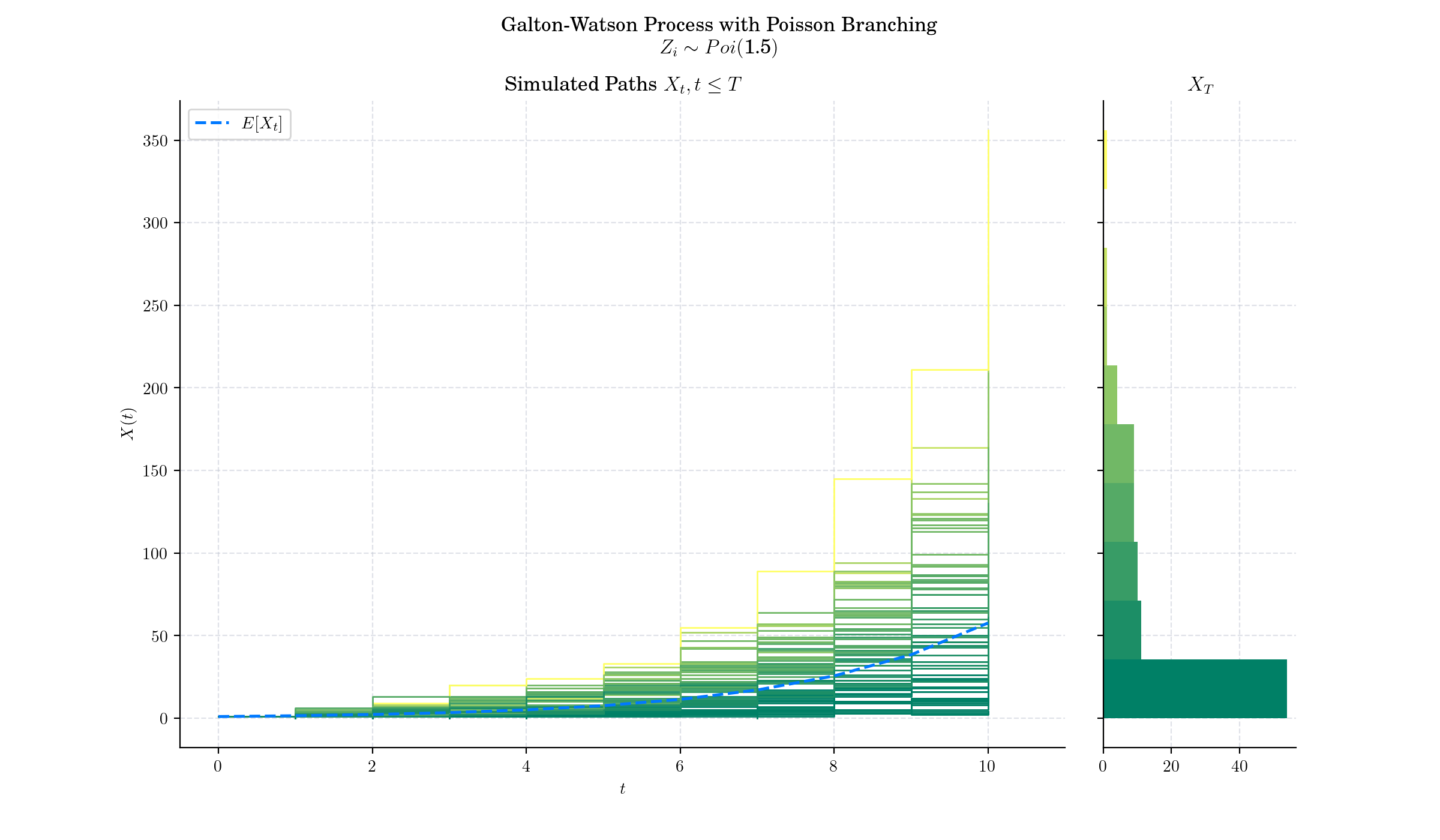
A Galton–Watson process is a stochastic process \(\{X_n : n \in \mathbb{N}\}\) which evolves according to the following recurrence formula:
\[X_{0} = 1,\]\[X_{n+1} = \sum_{j=1}^{X_n} Z_j^{(n)},\]where \(\{Z_j^{(n)}. : n, j \in \mathbb{N}\}\) is a set of independent and identically distributed (i.i.d) natural number-valued random variables. In this case, we assume tha they follow a Poisson distribution with parameter \(\mu>0\), i.e.:
\[Z_j^{(n)} \sim Poi(\mu).\]Constructor, Methods, and Attributes#
- __init__(mu=1.0, rng=None)[source]#
- Parameters:
mu (float) – the parameter \(\mu>0\) in the above definition
rng (numpy.random.Generator) – a custom random number generator
Methods
__init__([mu, rng])- parameter float mu:
the parameter \(\mu>0\) in the above definition
draw(N, n[, mode, title, style, colormap, ...])Simulates and plots paths/trajectories from the instanced stochastic process.
estimate_covariances([times])estimate_expectations()estimate_quantiles(q)estimate_stds()estimate_variances()marginal_expectation(generations)marginal_variance(generations)plot(N, n[, mode, title, suptitle, style, ...])Simulates and plots paths/trajectories from the instanced stochastic process.
process_covariance([times])process_expectation()process_stds()process_variance()sample([n])sample_upto([n])simulate(N, n)Simulate paths/trajectories from the instanced stochastic process.
simulate_upto(N[, generations])Simulate paths/trajectories from the instanced stochastic process.
Attributes
TEnd time of the process.
rng