aleatory.processes.BrownianMeander#
- class aleatory.processes.BrownianMeander(T=1.0, fixed_end=False, end=None, rng=None)[source]#
Brownian Meander#
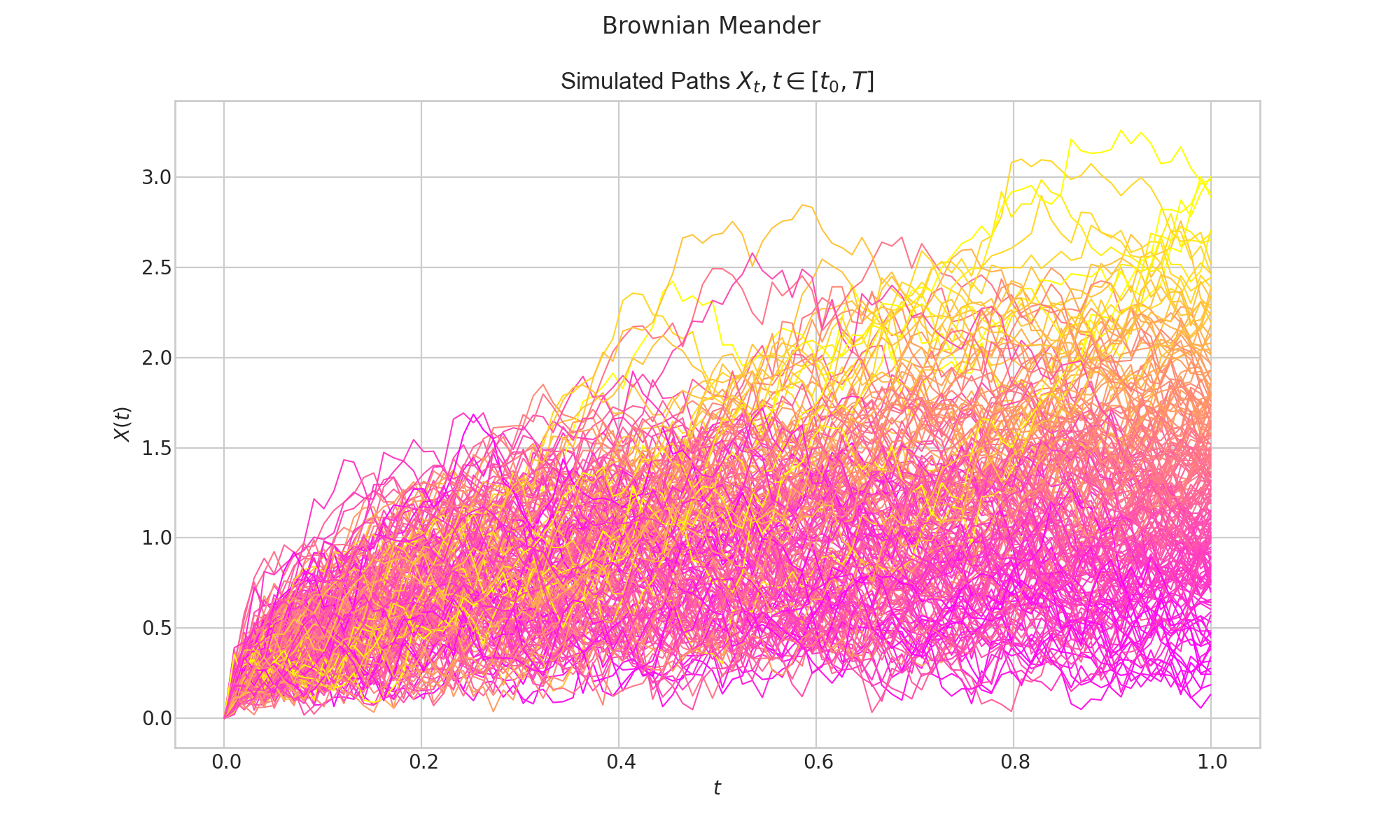
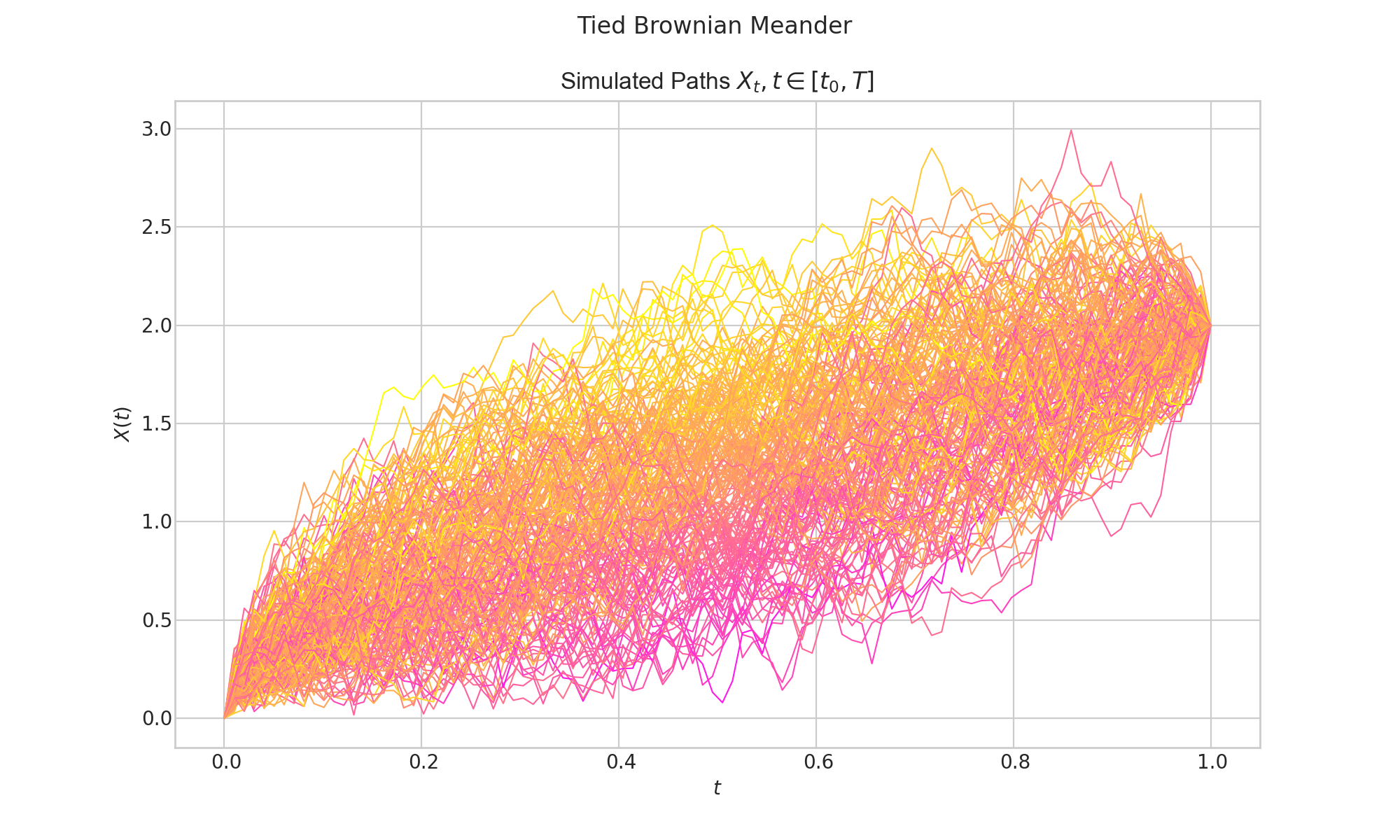
Notes#
Let \(\{W_t : t \geq 0\}\) be a standard Brownian motion and
\[\tau = \sup\{ t \in [0,1] : W_t =0\},\]i.e. the last time before t = 1 when \(W_t\) visits zero. Then the Brownian Meander is defined as follows
\[W_t^{+} = \frac{1}{\sqrt{1-\tau}} |W(\tau + t (1-\tau))|, \ \ \ \ t\in (0,1].\]Constructor, Methods, and Attributes#
- __init__(T=1.0, fixed_end=False, end=None, rng=None)[source]#
- Parameters:
T (float) – the right hand endpoint of the time interval \([0,T]\) for the process
fixed_end (bool) – flag to indicate if the process has a fixed end point. Defaults to False
end (float) – end point for the Meander, in the case of fixed_end equal True
rng (numpy.random.Generator) – a custom random number generator
Methods
__init__([T, fixed_end, end, rng])- param float T:
the right hand endpoint of the time interval \([0,T]\) for the process
draw(n, N[, title, suptitle])Simulates and plots paths/trajectories from the instanced stochastic process.
estimate_covariances([times])estimate_expectations()estimate_quantiles(q)estimate_stds()estimate_variances()plot(n, N[, T, title, suptitle])Simulates and plots paths/trajectories from the instanced stochastic process.
process_covariance([times])process_expectation()process_stds()process_variance()sample(n)sample_at(times)simulate(n, N[, T])Simulate paths/trajectories from the instanced stochastic process.
Attributes
TEnd time of the process.
endrng